MITCH KITTER

Security Leader  ·  Arctic Researcher  ·  Ph.D. Student

Director of Security Architecture at GCI. Researching the security and resilience of Alaska's critical telecommunications infrastructure at the University of Alaska Fairbanks.

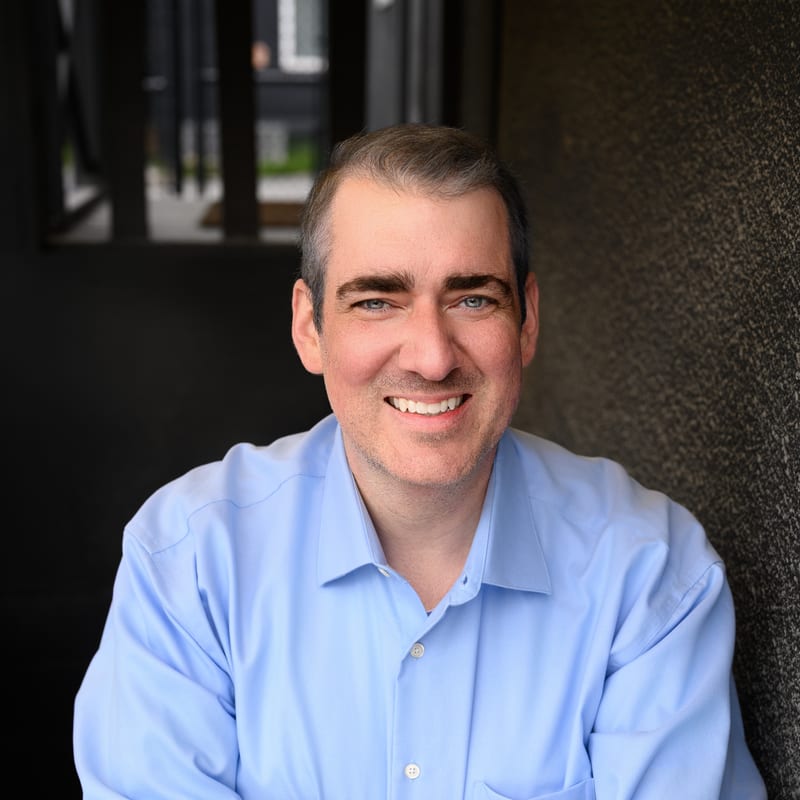
Mitch Kitter — Professional headshot

Built in Alaska. Shaped by It.

I grew up in Alaska and this state has shaped how I see the world: the scale, the isolation, the resilience, and the way communities here depend on infrastructure that most people never think about.

I care about making cybersecurity accessible, not just to technical teams but to the business leaders and end users whose decisions shape security outcomes every day. Most of what I do involves bridging that gap.

That same curiosity drove me back to school. I'm a Ph.D. student at the University of Alaska Fairbanks researching the cyber and physical security of Alaska's telecommunications infrastructure in an Arctic geopolitical context, specifically the gap between what practitioners experience on the ground and what the academic and policy literature addresses.

CISSP CISM PMP MBA Ph.D. Student
Dissertation Research

"Analyzing Security of Critical Telecommunications Infrastructure in Alaska: Cyber and Physical Risk and Resilience in a Strategic Arctic Context"

Alaska's telecommunications critical infrastructure faces escalating security risk driven by its strategic importance to national defense, aging physical assets, remote and inaccessible geographies, and the intensifying competition among great powers in the Arctic. This research investigates the nature, scope, and perception of those risks — and the organizational and structural barriers that stand in the way of addressing them.

Institution University of Alaska Fairbanks — Interdisciplinary Ph.D.
Committee Chair Dr. Arghya Das
Expected Completion Spring 2027

Research Questions

01

What internal, external, and natural threats confront Alaska's telecommunications infrastructure, and in what ways do these threats manifest as cyber and physical security risks?

02

What organizational, technical, regulatory, and geographic barriers limit the mitigation of these risks?

03

How are these risks perceived and prioritized by telecom security and risk leaders in Alaska?

Methodology

Literature Review

200+ sources spanning cybersecurity, Arctic geopolitics, critical infrastructure protection, and organizational resilience. Comparative analysis with Nordic nations, especially Finland.

Industry Survey

Anonymous online survey targeting Alaska telecom security and risk leaders — evaluating risk tradeoff decisions.

Take the survey →

Semi-Structured Interviews

In-depth interviews with selected survey respondents, capturing richer narrative context around risk decision-making, organizational constraints, and threat prioritization.

Why This Research Matters

Alaska sits at the intersection of great power competition, accelerating climate change, and a critical dependency on telecommunications infrastructure that cannot afford to fail. Recent events make this research urgent:

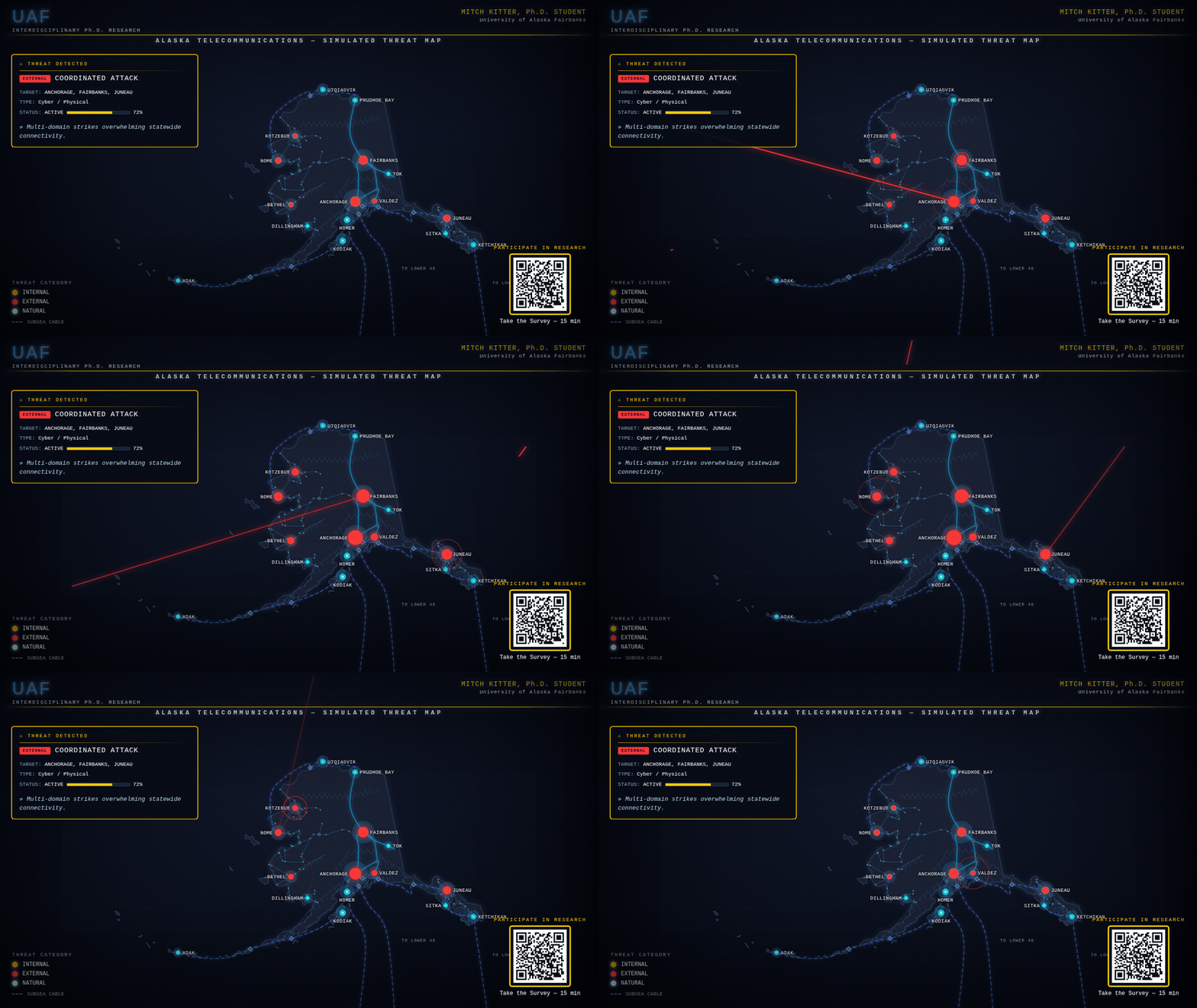
Animated simulated threat map showing a coordinated cyber and physical attack across Alaska's telecommunications network, with nodes at Anchorage, Fairbanks, Juneau and other communities lighting up under threat.
Simulated threat map — a coordinated, multi-domain attack on Alaska's telecommunications network, modeled from the research. Explore the live map →
2018

Matanuska-Susitna Borough declared a disaster following a devastating cyberattack that crippled borough systems for months.

2023

Chinese "Gate Crashers" were intercepted at Joint Base Elmendorf-Richardson, underscoring intelligence threats on Alaskan soil.

2024

Russian vessels engaged in cable-dragging incidents in the Baltic Sea, demonstrating the vulnerability of undersea telecommunications infrastructure.

2025

Chinese state-sponsored groups infiltrated major U.S. telecommunications providers, compromising sensitive communications infrastructure.

2026

Russia and China deepened Arctic cooperation agreements, formalizing coordination in a region where Alaska's infrastructure and security interests are directly at stake.

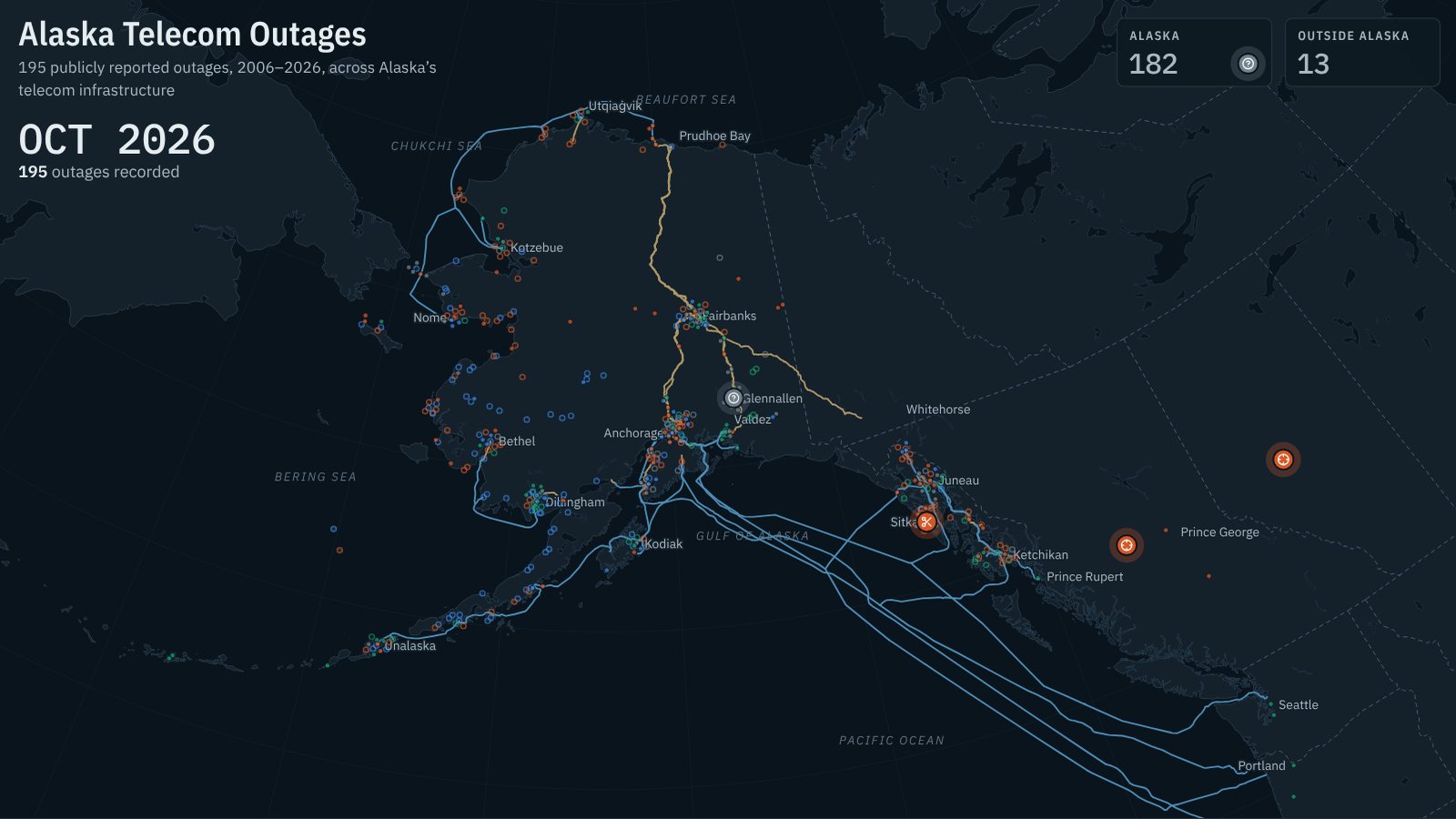
Since 2006, 195 outages across Alaska's telecommunications infrastructure have been publicly reported, from subsea cable breaks and fiber cuts to storms, earthquakes, power failures and equipment faults. The animated outage map plays two decades of them back on the state's fiber network, with sources for every event.

Map of Alaska's subsea and terrestrial fiber network marked with 195 publicly reported telecom outages from 2006 to 2026, colored by cause.
Outage record — two decades of publicly reported outages, mapped by cause and compiled for the research. Watch the animation →

This is not an abstract academic exercise. Alaska's telecommunications infrastructure is a strategic asset — and the people who protect it need research that reflects the reality they face.

CV & Background

Education

2025 – Present
Interdisciplinary Ph.D.
University of Alaska Fairbanks
Cybersecurity and resilience for Telecommunications Critical Infrastructure in the Arctic
2021
MBA, Business Administration
University of Alaska Anchorage
2016
BBA, Management & Marketing
University of Alaska Anchorage

Career

2018 – Present
Director, Security Architecture & Planning
GCI — Alaska's largest telecom provider
Security project management, strategic planning, and security architecture across the enterprise.
2016 – 2018
Senior Manager, Marketing
GCI
2007 – 2017
Partner
The Studio | PropagandaAK

Certifications

PMP
Project Management Professional
CISSP
Certified Information Systems Security Professional
CISM
Certified Information Security Manager

Publications & Speaking

  • Publication "LLMs: Loose Lips Multipliers?"
Cybersecurity

Power, Phishing, and the New Perimeter: Takeaways from the UA AI Symposium

I moderated the Infrastructure, Security & AI panel at the second University of Alaska AI Symposium. Alaska's infrastructure and security leaders weighed in on why power runs out first, where latency and sovereignty matter, how AI-driven phishing is forcing AI-driven defense, and why identity for non-human actors is now core security work.

Read more →

Get in Touch

I'm open to speaking engagements, research collaborations, and conversations about Arctic critical infrastructure security and resilience. Reach out anytime.

University of Alaska Fairbanks